


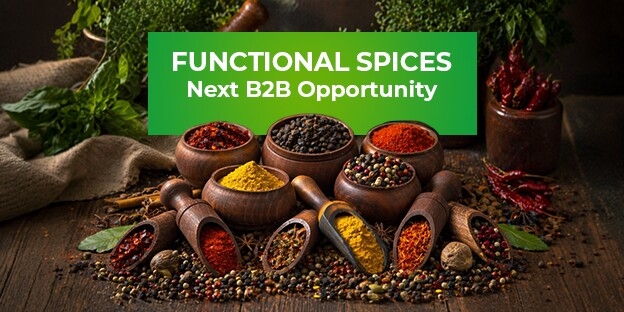
Something has shifted in the way spice buyers think. Five years ago, the conversation started and ended with flavour. Today, procurement teams are asking a very different question: what does this ingredient do beyond taste?
That shift is turning functional spices into one of the most profitable categories in B2B ingredient supply.
Functional Spices: More Than a Buzzword
Functional spices are spices that carry specific, research-backed health benefits alongside their culinary role.
For example, turmeric is known for its anti-inflammatory curcumin content, ginger for digestive support, cinnamon for blood sugar regulation, and black pepper as a bioavailability enhancer.
These aren’t made-up claims.
Curcumin alone has been the subject of over 400 clinical studies and more than 20,000 published citations on PubMed. The U.S. FDA classifies curcuminoids as GRAS (Generally Recognised as Safe), and clinical trials have demonstrated safety even at doses of up to 8 grams per day.
This kind of scientific backing is exactly what gives functional spices their commercial weight. Buyers don’t just want flavour anymore. They want ingredients they can build product claims around.
The Market Numbers Tell the Story –
The global functional food and beverage market stood at roughly USD 399 billion in 2025 and is projected to cross USD 983 billion by 2034, growing at a CAGR of about 10.65%. Within that broader wave, spices occupy a unique position because they serve dual duty: flavour and function, in a single raw material.
India already controls over 45% of global spice output, and FY 2024-25 was a record year with USD 4.72 billion in spice exports. Giving us a profitable position to be ahead of the competition.
What’s changing is why buyers are placing orders. Turmeric, ginger, cinnamon, and black pepper are among the top exported varieties, and their demand is increasingly driven by health-focused product development rather than traditional culinary use.
Meanwhile, the global blended spices market is projected to grow from USD 8.62 billion in 2025 to USD 9.28 billion in 2026 and USD 17.71 billion by 2034. The B2B segment within that space is growing at a CAGR of 8%, faster than the overall market.
Why These Margins Are Different?
Commodity spices compete on price. Functional spices compete on value. That distinction changes the entire economics of the deal.
- Premium positioning becomes possible –When a spice supports a product claim like immunity support or gut health, the buyer’s willingness to pay shifts. You’re no longer selling raw turmeric powder. You’re selling a clinically validated ingredient.
- Price sensitivity drops –Procurement decisions move from cost-first to outcome-first. A food manufacturer formulating a functional beverage isn’t shopping for the cheapest ginger extract. They need one with standardised gingerol levels and clean-label certifications.
- Client relationships get stickier –Once a formulation is built around a specific functional spice blend, switching suppliers carries real risk. That translates into longer contracts and more predictable revenue.
- Consistent demand stabilises –The real margin expansion kicks in when you start formulating blends around specific health outcomes. This ensures steadier B2B order cycles.
Where the Demand Is Coming From?
What makes functional spices so commercially interesting is that they don’t belong to just one industry. They show up in multiple places, and each sector uses them a little differently.
- In the food and beverage industry, the demand is for fortified snacks, ready-to-use spice mixes, and functional beverages like turmeric lattes and ginger-based wellness shots.
For example, an immunity blend that pairs turmeric with black pepper and ginger, to boost curcumin absorption. Or a digestive blend built on cumin, fennel, and coriander, three ingredients that have been combined in traditional Ayurvedic practice for centuries and are now finding their way into clinical nutrition products.
- The nutraceuticals industry uses them in capsules, herbal formulations, and dietary supplements.
- Pharmaceutical companies, particularly those working in Ayurvedic and herbal medicine, rely on standardised spice extracts as active botanical ingredients.
- Even personal care brands are formulating with turmeric and cinnamon for skincare and oral care lines.
- Hotels and restaurant chains are feeling the pull, too. Functional menus are no longer a novelty reserved for boutique wellness cafes.
- Mainstream hospitality brands are actively incorporating health-positioned dishes, and doing that consistently across locations demands a dependable supply of quality spice blends at scale.
Building a Supply Chain That Supports All of This –
Scaling in this space goes well beyond sourcing larger quantities of raw material. The buyers placing functional spice orders care about things that commodity buyers never asked about.
- Traceability – to know the origin of every batch, down to the farm cluster in some cases.
- Standardisation – to ensure content per batch is consistent, measurable, and documented.
- Certifications – stating organic, non-GMO, or export-grade.
- Processing capabilities – such as extraction, grinding, blending.
- Logistics efficiency – for on-time delivery and export.
India’s Spices Board has set up crop-specific Spices Parks in key production centres to support exactly this kind of value addition. The country’s target of USD 10 billion in spice exports by 2030 depends heavily on increasing the share of value-added products from roughly 48% to 70%. This is the gap that is waiting to be filled.
Where Kisan Agro Fits In?
Kisan Agro a trusted spices exporters in India, has planted itself right at the junction where old-school spice sourcing know-how meets the kind of precision modern B2B buyers expect.
In practice, that means working with medicinal-grade spice ingredients that come with verified active compound profiles, formulating custom blends designed for specific industry applications (not generic masala mixes repackaged with a wellness label), keeping batch-level quality tight enough to survive audits, and running private label manufacturing for brands that want to scale their functional product lines without sinking capital into processing infrastructure.
Kisan Agro isn’t chasing volume for volume’s sake. The play here is to solve formulation and supply chain problems for companies that have already committed to the functional ingredients space and need a partner who can keep up.
Conclusion –
Functional spices sit at the intersection of food, health, and convenience, which is precisely where global consumption is heading.
For B2B players willing to invest in blending capabilities, certifications, and long-term partnerships, the profit opportunity is real and growing. The market has already moved. The only question is whether your supply chain has kept up. Contact us now.
FAQs:
1] What are functional spices?
Functional spices are spices offering specific health benefits beyond flavour, such as turmeric for inflammation or ginger for digestion.
2] Why are functional spices profitable in B2B markets?
They command premium pricing because they enable product health claims, reduce price sensitivity, and drive longer supplier contracts.
3] How to scale a functional spice business?
Invest in blending and formulation capabilities, secure clean-label certifications, and build long-term partnerships rather than one-off bulk deals.
4] What are the benefits of functional spices for food manufacturers?
They help create differentiated products, support health-related label claims, and reduce reliance on synthetic additives.
5] Which industries benefit the most from functional spices?
Food and beverage, nutraceuticals, pharmaceuticals, personal care, and HoReCa see the strongest demand.
6] What are the most in-demand functional spices globally?
Turmeric, ginger, cinnamon, black pepper, and clove lead global demand due to their well-documented health properties.
7] How can B2B buyers source high-quality functional spices?
By partnering with suppliers who offer traceability, standardised active compound levels, relevant certifications, and consistent bulk supply.
