


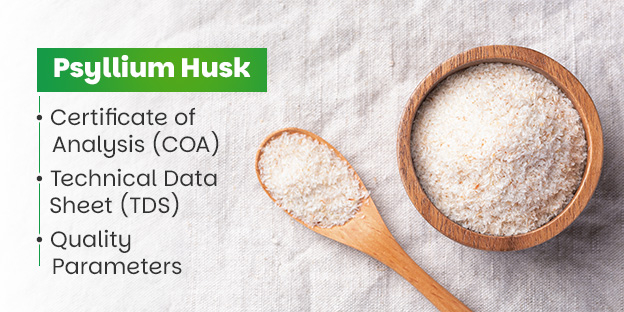
What is Certificate of Analysis COA for Psyllium Husk?
Certificate of Analysis (COA) includes details such as the batch number, manufacturing date, expiry date, purity level, moisture content, swelling index, microbiological results, and heavy metal analysis. By reviewing these results, buyers can verify that the product complies with their quality and safety requirements.
If you are producing psyllium husk, you’ve probably come across requests for documents like a COA or TDS from many of your customers. These are the documents play an important role for the buyer to get confirm a product quality and understand exactly what they are purchasing in Psyllium.
As you know the Psyllium husk is obtained from the seeds of Plantago ovata (a botanical name of psyllium) and it is used across the food, pharmaceutical, nutraceutical, and dietary supplement industries. Its plus point is that it is having high fiber content and its ability to absorb water and form a gel-like texture. Because of these properties, psyllium is mostly demanded in the digestive health products, fiber supplements, and various food applications.
For manufacturers, importers, and distributors, the COA serves as proof that the supplied psyllium husk has been tested and meets the agreed specifications. This helps ensure consistency, transparency, and confidence throughout the supply chain.
What Information Typically Included in a Psyllium Husk COA?
- Product Name
- Batch/Lot Number
- Manufacturing Date
- Expiry Date
- Country of Origin
- Test Parameters and Results
- Specification Limits
- Test Methods Used
- Authorized Signature
What are the Common Parameters Tested in a Psyllium Husk COA?
- Purity
- Moisture Content
- Swelling Index
- Bulk Density
- Particle Size
- Total Ash
- Microbiological Analysis
- Heavy Metal Analysis
- Pesticide Residue Status
The COA provides assurance that the specific batch being supplied meets the agreed quality standards.
What is Psyllium Husk Technical Data Sheet (TDS)?
These document that outlines the physical and technical features of the product. It consists of details like botanical name, visual characteristics, purity grade, moisture percentage, swelling index, mesh specification, packaging information, storage requirements, and expiration period. In contrast to a COA, a TDS is not specific to a batch and details the standard characteristics of the product.
What Information Typically Included in a Psyllium TDS?
- Botanical Name (Plantago ovata)
- Product Description
- Appearance
- Color
- Odor and Taste
- Purity Levels
- Swelling Index
- Moisture Content
- Bulk Density
- Mesh Size
- Packaging Details
- Shelf Life
- Storage Conditions
- Applications
The TDS helps buyers determine whether the product is suitable for their intended use before placing an order.
What are The Quality Parameters Important in Evaluating Psyllium Husk?
There are many quality parameters which are important when we are evaluating psyllium husk. The Purity is one of the key factors, with other common grades ranging from 95% to 99%. The swelling index measures the husk’s ability to absorb water and form a gel, while moisture content affects shelf life and product stability.
Other important parameters include mesh size, bulk density, microbiological quality, and heavy metal compliance. Testing for contaminants such as E. coli, Salmonella, lead, and arsenic helps ensure product safety and regulatory compliance.
By understanding the COA, TDS, and key quality parameters, buyers can confidently select psyllium husk that meets their quality, safety, and application requirements.
Looking for premium-quality psyllium husk backed by complete COA and TDS documentation? Contact Kisan Agro, a trusted psyllium husk exporter, manufacturer and supplier, for consistent quality, regulatory compliance, and reliable global supply.
FAQs:
1. What does TDS stand for in psyllium husk products?
TDS stands for Technical Data Sheet. It is a document that provides detailed technical specifications and physical characteristics of psyllium husk, helping buyers understand the product’s properties and applications.
2. Why are COA and TDS important when purchasing psyllium husk?
Both documents help buyers verify product quality, consistency, and compliance with regulatory requirements. They also support supplier qualification, product approval, and import-export documentation processes.
3. What information is typically included in a psyllium husk COA?
A COA generally includes the product name, batch number, manufacturing date, expiry date, purity, moisture content, swelling index, microbiological results, heavy metal analysis, and test methods used.
4. What information can be found in a psyllium husk TDS?
A TDS typically contains product description, botanical name, appearance, purity level, moisture content, swelling index, mesh size, packaging details, storage conditions, shelf life, and recommended applications.
5. What is the purity level of psyllium husk?
Commercial psyllium husk is commonly available in 95%, 98%, and 99% purity grades. Higher purity grades contain fewer seed particles and foreign materials, making them suitable for premium applications.
6. Why is moisture content an important quality parameter?
Moisture content affects product stability, shelf life, and susceptibility to microbial growth. Lower moisture levels help maintain product quality during storage and transportation.
7. What are microbial limits in a psyllium husk COA?
Microbial limits refer to the acceptable levels of microorganisms such as Total Plate Count, Yeast & Mold, Coliforms, E. coli, and Salmonella. The tests help ensure the product is safe for consumption and complies with regulatory standards.
8. Why is heavy metal testing important for psyllium husk?
Heavy metal testing helps detect contaminants such as lead, arsenic, cadmium, and mercury. Compliance with heavy metal limits is essential for food safety and international regulatory requirements.
9. How does mesh size appear in a TDS?
The Mesh size is usually listed as a numerical specification such as 40 Mesh, 60 Mesh, 80 Mesh, or 100 Mesh. It indicates the particle size and helps buyers select the appropriate grade for their application.
10. What is a batch number on a COA?
A batch number is a unique identification code assigned to a specific production lot. It enables traceability and helps manufacturers track product quality throughout the supply chain.
11. What is the difference between a COA and a TDS?
The COA is batch-specific and provides actual test results for a particular lot of psyllium husk. A TDS is a general product specification document that describes the standard characteristics and technical properties of the product.
